Quick summary
- The passage is carved into the glacier rather than opened up by meltwater or a natural collapse.
- At 3,000 metres the air is already colder than the valley, and the ice passage is colder again.
- There is no boardwalk here. You walk on the glacier itself, so flat, grippy shoes make a real difference.
- Access is included in the tour but depends on conditions at the summit, the same as the Cliff Walk and the chairlift.
A cave cut into moving ice
The Titlis glacier cave sits at around 3,000 metres, cut straight into the body of the glacier rather than opened up by meltwater or a collapse. That distinction matters: the ice caves people usually picture, the kind with smooth blue tunnels carved by running water, form and vanish on their own schedule and are often unsafe to enter. This one exists because a passage was cut through solid ice on purpose, which is the reason it can be walked through reliably instead of visited on the glacier's own terms.
A glacier is not a static block of ice. It is a mass that moves, slowly, under its own weight, grinding downhill over the rock beneath it. Walking through a passage cut into that mass means walking inside something that is technically still in motion, even if nothing about the visit feels like it. That is a fairly rare thing to do on a day trip, and it is worth treating as the point of the stop rather than a corridor between the cable car and the next photo.
How cold it actually is
At 3,000 metres the air is thinner, the sun is noticeably stronger, and the ambient temperature runs well below whatever the valley is experiencing on the same day. That difference is real before you even reach the ice: step off the cable car into bright sun and the cold still catches people out.
Inside the passage itself, the walls are ice on every side, and ice at that altitude does not warm up the way a shaded room does. It is colder in there than it is outside on the platform, which is already colder than Lucerne or Engelberg. Treat the summit as a different climate from the valley you started the day in, and dress for that rather than for wherever the coach picked you up.
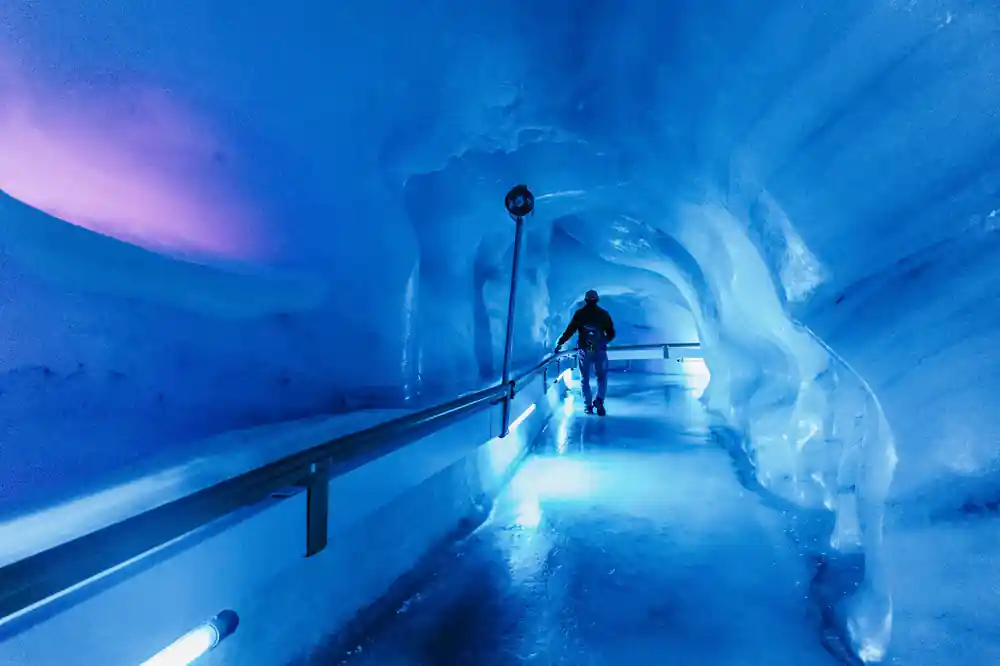
The ice passage, cut straight into the glacier at the summit
The floor is ice, and it shows
The ground underfoot through the passage is the glacier itself, not a boarded walkway laid on top of it. That means the surface is ice, worn smooth in places by the feet that cross it every season, and it is slippery in exactly the way any ice floor is slippery, whatever the weather is doing outside.
Trainers with worn soles, or anything with a smooth sole, are the wrong choice here. Flat, grippy footwear makes the walk straightforward; anything else turns a short walk into a careful shuffle. It is a small thing to get right and an easy one to get wrong if you dressed for a morning in Lucerne and forgot that the last stop of the day is on ice.
Why the ice looks blue
Ice that has been compressed for a long time behaves differently to the ice in a freezer tray. As snow packs down into solid glacier ice, the trapped air is squeezed out and the crystal structure tightens, and dense ice like this absorbs the red end of daylight more than the blue end. What comes back to your eye, especially where the passage runs thickest, reads as a cold, saturated blue rather than the white or grey of ordinary ice.
It is physics rather than anything added to the ice, and it is one of the few points on the whole day where the colour of the thing in front of you is not really open to interpretation. Photographs taken inside the passage tend to undersell it with a flash on and oversell it with a flash off, so it is worth a proper look with your own eyes rather than trusting the screen.
3,000 m
The altitude of the glacier cave and the rest of the summit attractions, high enough that valley weather tells you nothing about conditions up here.
Included, and weather permitting
The glacier cave is one of the inclusions on this tour, bundled with the Titlis Cliff Walk under the same weather-permitting condition as the Ice Flyer chairlift. Nothing extra is booked or paid for on the day to walk through it. The condition is entirely about the mountain, not about your ticket.
Weather permitting means what it says at 3,000 metres: high wind, heavy snowfall or low visibility can close any of the summit attractions with little notice, and the decision sits with the mountain operator rather than with your guide. The operator also states that from June 2026, because a new Titlis tower and mountain station are under construction, summit visits are limited to about an hour of activities before the group heads down to the Trubsee middle station, where there are restaurant facilities. That is a temporary arrangement tied to the building work, not a permanent feature of the mountain, and it is one more reason not to expect a leisurely amount of time at the top.
What else is at the summit
The glacier cave is one stop among several at the top. The other headline inclusion is the Titlis Cliff Walk, a suspension bridge slung across the mountain, and getting up there in the first place means a cable car ride, either the Rotair, which revolves during the ascent so the view turns without you moving, or the Titlis Connect, which does not.
None of this is fully under your control on the day. Which attractions are open, and for how long, depends on the weather, the season, and currently the construction work reshaping the summit station. The safest assumption for planning purposes is that the glacier cave, the Cliff Walk and the chairlift are all conditional rather than guaranteed, and that a clear, calm day gives you the best chance of doing all three.
One of the few places you can walk inside a glacier
from US$199Reserve now & pay later